
Two Brontës, Two Worlds
Chaos and Quiet Survival in Wuthering Heights and Agnes Grey

Just before 2025 ended, I read two novels by the Brontë sisters back to back: Wuthering Heights by Emily Brontë and Agnes Grey by Anne Brontë. It wasn’t a deliberate experiment, but reading them consecutively made their differences impossible to ignore. Despite being written within the same era and family, the books reveal strikingly distinct approaches to language, character, and emotional focus.
For those unfamiliar with the Brontë sisters, a brief overview helps set the scene. Charlotte, Emily, and Anne Brontë were born in Yorkshire, England, in the early 19th century. All three published novels under male pseudonyms and became influential literary figures of their time. Tragically, each of them died in their thirties, yet their work has endured for nearly two centuries. Charlotte was the most commercially successful during her lifetime, particularly after the publication of Jane Eyre, but Emily and Anne left behind works that continue to provoke and resonate in different ways.
One thing that always strikes me when reading 19th-century literature is the omnipresence of illness. Characters succumb easily to fevers, weakness, and unnamed ailments. There is something both haunting and oddly tender about how fragile everyone seems, as if life itself is always on the verge of slipping away. Considering the Brontës’ own lives, shaped by limited medical knowledge and the absence of antibiotics or vaccines, illness begins to feel less like a plot device and more like a silent character, constantly lurking in the background.
Nowhere is this more apparent than in Wuthering Heights. I have rarely encountered a novel so saturated with physical and emotional sickness. Nearly every character seems consumed by some form of bodily or mental deterioration, and this is saying something, as I’ve read The Plague by Albert Camus. At its core, Wuthering Heights is a story of obsession, revenge, and cruelty. Its language is deeply Victorian, and the novel is permeated by a gothic darkness that never quite lifts.
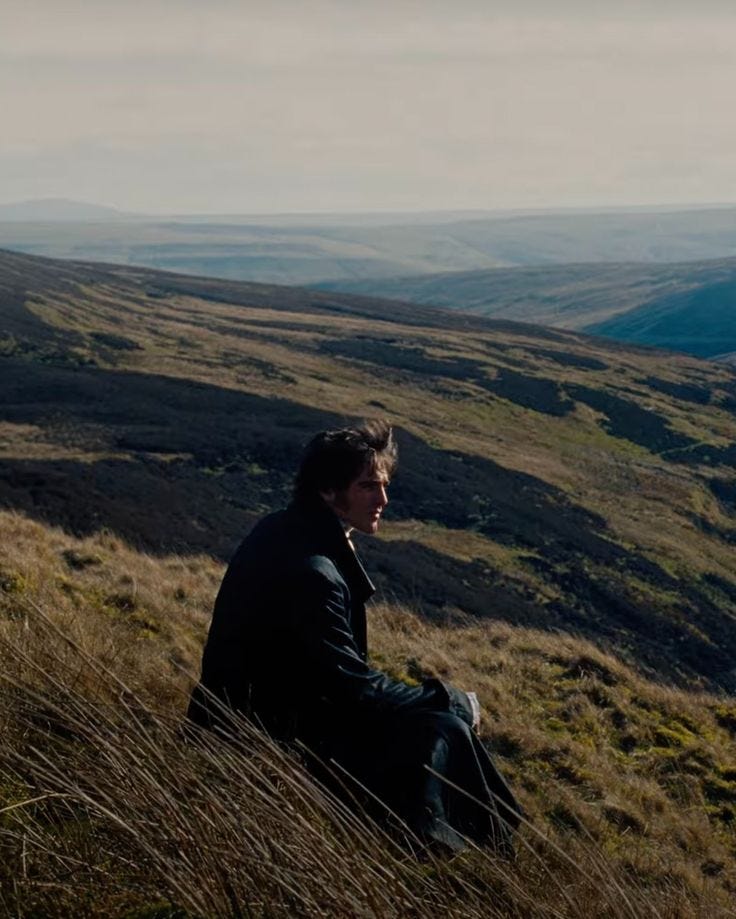
The story opens with Mr. Lockwood, a tenant renting Thrushcross Grange from the abrasive and withdrawn Mr. Heathcliff, who lives at the nearby estate Wuthering Heights. During a visit, a snowstorm traps Lockwood overnight at the house, where he experiences disturbing dreams involving the ghost of Catherine Earnshaw. Intrigued and unsettled, he later asks Nelly Dean, the housekeeper, to recount the history of the Earnshaw and Linton families and explain how Heathcliff came to own Wuthering Heights.
This framing device becomes crucial. While reading the novel, I initially accepted the idea that Heathcliff was simply one of the most cruel and detestable characters in literature. Yet after finishing the book, I found myself questioning how much of that judgment was shaped by Nelly Dean’s narration. She is, after all, telling the story from her own perspective, and Heathcliff’s voice is largely absent.
What we do know of Heathcliff’s past is bleak. He is found alone on the streets of Liverpool as a child and brought to Wuthering Heights by Mr. Earnshaw, who intends to raise him as one of his own children. Instead, Heathcliff is treated as an outsider by nearly everyone in the household, including Mrs. Earnshaw and Nelly herself. His only true companion is Catherine Earnshaw, who becomes his confidant and emotional anchor. After Mr. Earnshaw’s death, Hindley (the oldest son) inherits the estate and subjects Heathcliff to relentless cruelty. When Catherine later marries Edgar Linton, Heathcliff disappears for three years, returning transformed: wealthier, stronger, and consumed by vengeance.
None of this excuses his actions, but it does complicate them. His thirst for revenge does not arise from nothing. Given Nelly Dean’s early hostility toward him, it is worth considering whether her account casts Heathcliff in the harshest possible light when she is retelling the story. That ambiguity, intentional or not, adds another layer to Emily Brontë’s already turbulent novel.
Agnes Grey, by contrast, inhabits a very different emotional register. There are fewer sickly characters, and the language feels noticeably more restrained and modern. Often described as semi-autobiographical, the novel draws from Anne Brontë’s experiences as a governess, and that realism is evident throughout. The overbearing parents, the spoiled children, and Agnes’s quiet struggle to assert herself all feel grounded and familiar.
Agnes’s inner world is rendered with particular care. Her loneliness, self-doubt, and longing for dignity resonate strongly, even now. When she reflects,
”Sometimes on such occasions, the thought has suddenly occurred to me - ”if they could see me now!” meaning, of course, my friends at home, and the idea of how they would pity me has made me pity myself”
the sentiment feels timeless. Most of us have experienced moments like this, whether in a new job, a new city, or among strangers where we feel unseen and uncertain.
Compared to the emotional chaos of Wuthering Heights, Agnes Grey feels gentler and more intimate. Agnes is an introverted observer, trying to navigate a world that consistently underestimates her. Her story is lighter in tone, but no less sharp in its social critique, particularly in its portrayal of class, gender, and quiet endurance.
Perhaps this contrast reveals each author’s greatest strength. Anne Brontë excels at portraying interiority, the subtle movements of thought and feeling that shape a person’s moral life. Emily Brontë, on the other hand, constructs a world of intensity and destruction, where emotions are unchecked and consequences echo across generations. Reading the two novels side by side highlights not only their differences, but the remarkable range that existed within the Brontë family itself.
If you’ve read both Wuthering Heights and Agnes Grey, which one stayed with you longer, and do you think that says more about the book or about you as a reader?
*This post was written as I myself had the flu, so I might have reflected a bit much on the sickly parts from the books :)
If you enjoyed this post, please consider pressing the like button. And if you’d like more reflections, reviews, and curated lists of cultural happenings, I invite you to subscribe to The Classics List.
I have yet to read Agnes Grey but Wuthering Heights is one of my favorite books ever! Back in the day I was a huge fan of the Kate Bush song (still am) and when I later heard it was based on an actual book, I got my dad to check it out for me (in translation). I can't have been much older than 12 and most of the novel's layers and nuances were lost on me but a couple of years later I had to read it in English for school and I've been rereading it every couple of years or so. And every time I read it feels like I'm transported to another world. Brontë's characters are both extremely flawed and fascinating.
A couple of decent scholarly articles have been written about Nelly's role in the story and while I myself don't cast Nelly as the villain, she certainly plays a big part in the outcome of certain key moments in the narrative. An innocent bystander, she definitely is not.
This was a very interesting read! I read Agnes Grey just before Christmas and loved how she wrote interiority. I am also a nanny/governess so it was wildly relatable for me. I found myself comparing and contrasting it with Jane Eyre more than Wuthering Heights, as there are similarities in terms of the protagonists being governesses etc.
It’s been years since I read Wuthering Heights but it’s one of those books that is so unique and captivating, I find myself reflecting on the story and its characters often. Definitely time for a reread!