
The Evil That Grows Quietly
Stephen King’s early masterpiece taught me that horror isn’t about monsters, it’s about the people who look away.

Each fall, I feel an almost magnetic pull towards Stephen King’s novels. There is something about the shorter days and the smell of damp autumn leaves that make me crave the kind of darkness he writes. Yet every year, the enthusiasm fades the moment I open his back catalogue. Choosing among his dozens of novels feels less like browsing and more like decision paralysis (perhaps an affliction familiar to any Libra, if one believes in that sort of thing).
This year, I tried something new. I asked on Substack Notes which King novel one should read. The responses poured in:
Pet Sematary - When a young family moves to rural Maine, they discover a burial ground that holds the power to bring back the dead.
The Shining - A struggling writer takes a winter caretaker job at an isolated mountain hotel, where his family becomes trapped and his mind begins to unravel under the building’s influence.
The Long Walk - In a near-future America, one hundred teenage boys are forced to compete in a deadly endurance contest where only one is allowed to survive.
Needful Things - A mysterious shop opens in a small Maine town, offering every customer exactly what they most desire, but at a terrible personal cost.
Fairy Tale - A teenage boy inherits the keys to a hidden world where good and evil wage in ancient battle.
11/22/63 - A high-school teacher discovers a portal to a past and attempts to prevent the assassination of John F. Kennedy.
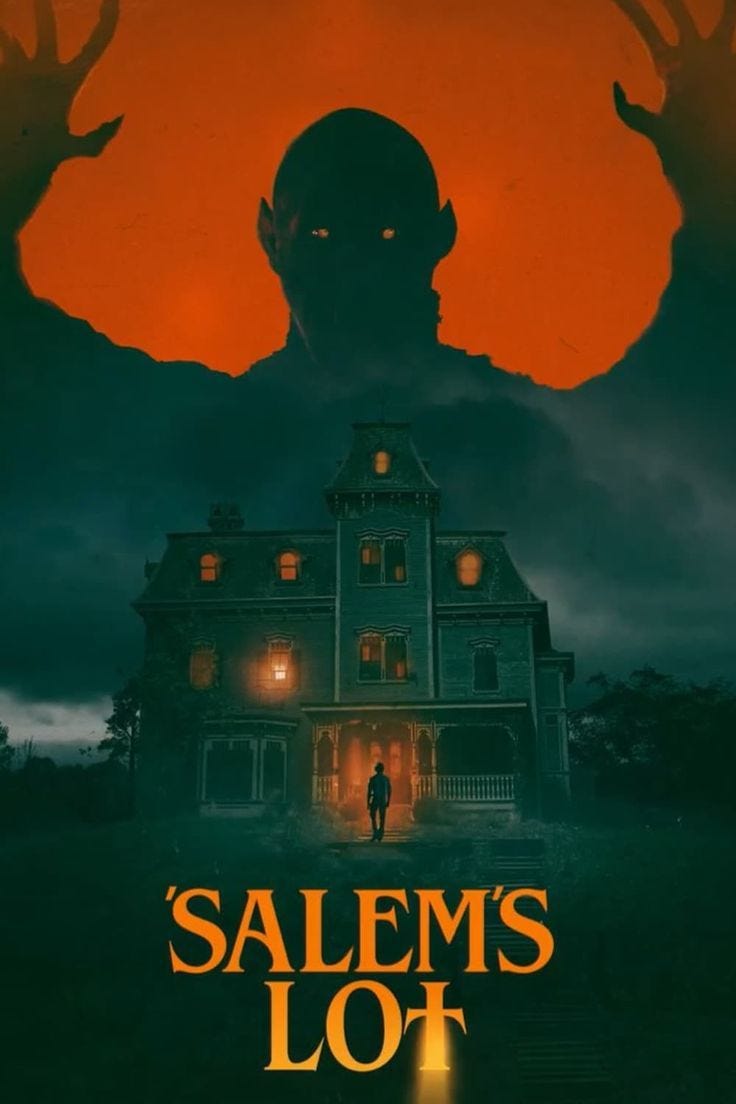
But the one that stood out the most was King’s novel ’Salem’s Lot. And when I realized it was his second published novel, following his 1974 debut Carrie, the choice became clear. Reading chronologically felt like tracing an artist’s early evolution, from high school locker rooms to haunted corners of a small Maine town.
Unlike Carrie, whose story burns fast and burst of psychic teenage fury, ’Salem’s Lot unfolds slowly, like rot under a coat of paint. The novel is set in Jerusalem’s Lot, a quiet, slightly forgotten town in Maine, a place of gossip and quiet desperation. Where everyone knows each other’s sins and no one quite wants to talk about them. There are housewives who linger by the window, men who drink too early in the day, teenagers circling restlessly through town. King doesn’t just describe a setting; he constructs an ecosystem and ’Salem’s Lot becomes the story itself; a vibrant main character who’s pace, gossip and weary moral compromises it to the point of no return.
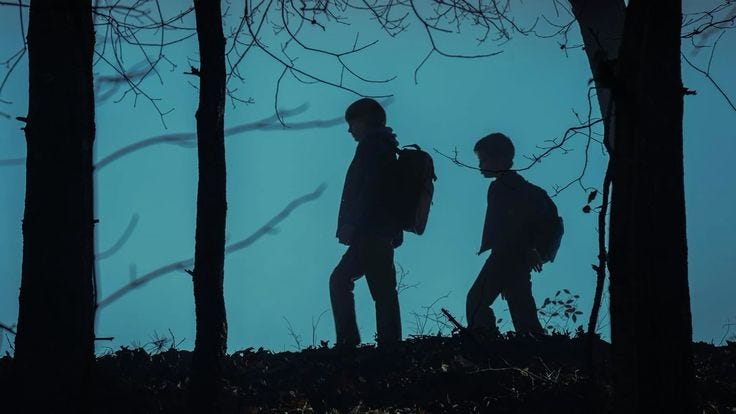
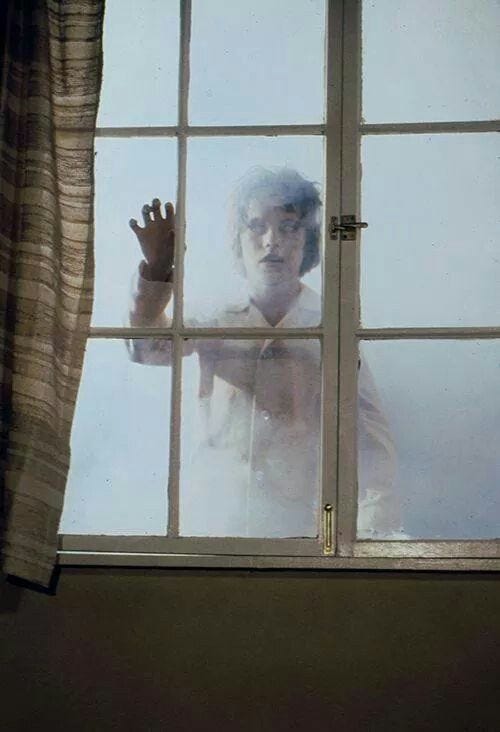
When two brothers wander into the woods and only one comes back, the air changes. The ordinary begins to decay slowly. The fabric of this fragile world begins to tear and what follows is both literal and symbolic; an infection that spreads through the town’s veins, exposing the vulnerability of moral.
One of the common criticisms of King is that he doesn’t ”kill his darlings.” In ’Salem’s Lot, the story occasionally strains under the weight of its own population. The dump overseer Dud Rogers, the adulterous Bonnie Sawyer and her lover Corey Bryant, even the rats that haunt the dump, are each vividly sketched and seemingly important at first, but then simply abandoned as the novel accelerates. But on the other hand, small towns are full of half-told stories, of people who never get their resolutions and maybe this messiness is what makes the town feel alive beyond the wording on the pages.
Two characters in particular, Susan Norton and Mabel Werts, embody the tension between belief and denial that runs through the book. Susan is drawn to the novel’s central mystery and dither between rationality and intuition, whereas Mabel, the local gossip, becomes an unwitting oracle of truth. Both act in ways that betray their stated convictions. This inconsistencies make them human. It is not about good versus evil, but more so about the small ways people rationalize the unthinkable until it is too late.
What stays with me after closing ’Salem’s Lot is not the monsters. It is the town itself. It pulses with something vital: that evil does not just invade from the outside but grows quietly within our habits and homes.
If you enjoyed this post, please make sure to press the like button. If you want to read more reflections like this, book reviews/recommendations and curated lists of cultural happenings, make sure to subscribe to The Classics List.
I've read some of Stephen King's novels, like Carrie, IT and the The Shinning.
I haven't read Salem's Lot yet, but consider my interest piqued by your post.
Thank you.