
A Murakami Girl
finding a literary home in Murakami's world

I remember being fifteen, reading book after book in my room because I had nothing better to do. When I reached the end of a stack, I would head to my nearest bookstore and spend my allowance on whatever came next. It felt like a fair trade. They always had a “buy four, pay for three” deal on paperbacks, and even if I was only interested in two or three, I tried to make it count. So I wandered every aisle, picking up books, turning them over, and reading the blurbs with unusual care.
One day, while doing exactly that, I came across something that stopped me. A runaway fifteen-year-old boy. Cats that talk to people. Fish falling from the sky. It sounded so strange that I had to buy it. The book was Kafka on the Shore by Haruki Murakami. What I didn’t know, standing there with that paperback in my hands, was that this would become the start of a long and meaningful relationship with his stories.
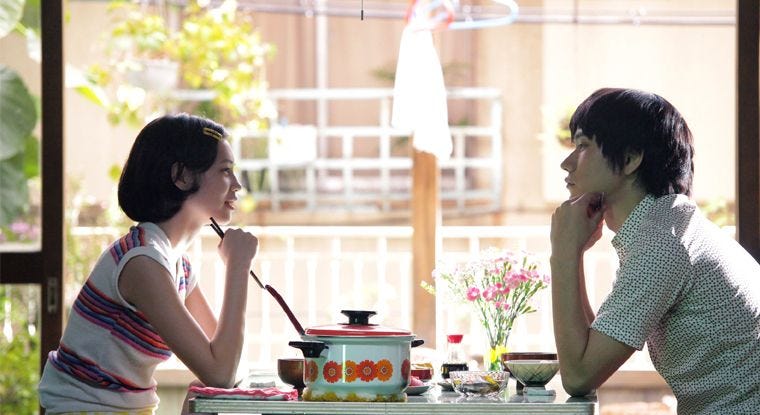
I’m still not entirely sure what it is about Murakami’s world that drew me in so completely. As I read more of his work, I started to notice a kind of pattern. The main character is often a young man, a bit lost, with complicated relationships. He lives alone, spends his time writing or listening to jazz, and visits the same quiet bar. There is often a cat somewhere in the story. Everything feels ordinary at first. Then something shifts. A phone call, a wrong turn, a strange encounter. Suddenly the world opens into something else entirely. A parallel reality. Dreams blending into life.
There was a comfort in his stories that is hard to explain unless you’ve felt it yourself. It reminded me of the feeling I had when I read the Harry Potter books. That sense of stepping into a world I didn’t want to leave. I used to imagine walking through the streets of Japan the way his characters did, as if I could somehow enter that same quiet, surreal atmosphere.
Over the years, I read every Murakami book I could find. Then university happened. Maybe it was the pressure of studies, or just shifting interests, but I slowly drifted away from reading, and from Murakami too.
While I was working on my master’s thesis at a research hospital, I happened to sit next to a PhD student from Japan during lunch one day. I remember saying something a long the lines of Tokyo being one of my dream cities to visit and that I loved reading Haruki Murakami. He looked at me, sighed, and said, “Oh, you are one of those girls.”
Ten years later, I still don’t quite know what he meant. Maybe it was his way of calling me basic. Maybe it was a language barrier thing. Or maybe there really is a certain type of girl who loves Murakami’s world. Either way, I don’t mind carrying that label. Haruki Murakami’s stories showed me a new way of writing. They introduced me to magical realism and they made me long for a city 7,000 miles away.
This year, I’ll return to Murakami again by diving into his latest release, The City and Its Uncertain Walls. I imagine it will feel a bit like coming home.
In the spring of her twenty-second year, Sumire fell in love for the first time in her life. An intense love, a veritable tornado sweeping across the plains-flattening everything in its path, tossing things up in the air, ripping them to shreds, crushing them to bits.
- Sputnik Sweetheart by Haruki Murakami
If you want to start reading Haruki Murakami
Begin here:
Norwegian Wood
Toru Watanabe looks back on his youth in Tokyo, where he becomes emotionally entangled with Naoko, the fragile girlfriend of his late best friend, and Midori, a lively and independent classmate. As he moves between them, he is forced to confront grief, mental illness, and the uncertainty of growing up.
Sputnik Sweetheart
K., a young teacher, is in love with his friend Sumire, an aspiring writer who becomes fascinated with an older woman named Miu. When Sumire disappears on a small Greek island, K. is drawn into the mystery, uncovering strange details that blur the line between reality and something more elusive.
Colorless Tsukuru Tazaki and His Years of Pilgrimage
Tsukuru Tazaki is suddenly cut off by his close group of friends without explanation during his youth. Years later, still haunted by their rejection, he sets out to find each of them and uncover what really happened, retracing the past to understand his place in it.
After Dark
Over the course of a single night in Tokyo, Mari meets a series of strangers, including a jazz musician and a former wrestler, while her sister lies in an unexplained deep sleep. Their stories unfold in parallel, connected by the quiet, uncanny atmosphere of the city after midnight.
If you want to fully dive in:
Kafka on the Shore
Kafka Tamura runs away from home to escape a dark prophecy, while an elderly man named Nakata, who can talk to cats, searches for a missing one. Their paths unfold in alternating chapters, gradually intertwining in a world where memory, fate, and the supernatural collide.
The Wind-Up Bird Chronicle
When Toru Okada’s cat goes missing, followed by his wife, he begins a strange search that leads him into abandoned houses, dry wells, and encounters with deeply unsettling people. As he digs deeper, his personal story becomes entangled with hidden histories and wartime memories.
1Q84
Aomame, an assassin, and Tengo, a writer, find themselves in a slightly altered version of Tokyo where two moons hang in the sky. As their separate lives unfold, both become entangled in a mysterious cult and a strange manuscript, moving toward a connection that seems destined yet uncertain.
If you enjoyed this post, consider subscribing to The Classics List, a weekly newsletter devoted to classic books and cultural happenings. We also host a community chat where we gather for book club discussions at the end of each month. Our May selection is Of Mice and Men by John Steinbeck, and we would love for you to join us.
Thanks! I'm ashamed to admit that I haven't read yet Murakami fiction. I'll follow your suggestions and start with Norwegian Wood.